
The Short Answer
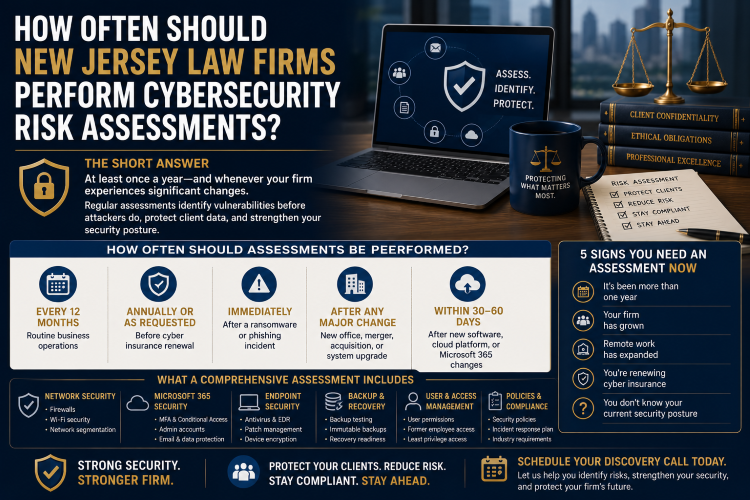
For most New Jersey law firms with 15–75 employees, a comprehensive cybersecurity risk assessment should be performed at least once every year. However, annual assessments alone are often not enough.
Your firm should also conduct a cybersecurity assessment after major technology changes, office relocations, mergers, ransomware incidents, cyber insurance renewals, or whenever new legal software or cloud platforms are introduced.
Think of a cybersecurity assessment like an annual physical for your technology. It identifies vulnerabilities before cybercriminals do, helps ensure confidential client information remains protected, and provides a roadmap for improving your firm's overall security posture.
If it's been more than 12 months since your last assessment—or if you're unsure whether one has ever been completed—it's time to schedule one.
Find out how we can help you schedule your discovery call. https://go.scheduleyou.in/QeuydhB4km?cid=is:~Contact.Id~
Why Cybersecurity Assessments Matter More Than Ever
Law firms have become one of the most attractive targets for cybercriminals.
Why?
Because they store:
- Confidential client communications
- Litigation documents
- Financial information
- Intellectual property
- Personally identifiable information (PII)
- Wire transfer instructions
Unlike many businesses, law firms also have ethical responsibilities to safeguard client information.
A cybersecurity assessment helps answer an important question:
"If someone tried to attack our firm today, where would they succeed?"
The goal isn't to find perfection—it's to identify and reduce unnecessary risk before it becomes an expensive problem.
What Is a Cybersecurity Risk Assessment?
A cybersecurity risk assessment is a structured review of your firm's technology environment.
Rather than looking at just one computer or server, it evaluates your entire IT ecosystem.
A typical assessment includes:
- Workstations and laptops
- Servers
- Firewalls
- Wi-Fi networks
- Microsoft 365
- Cloud applications
- User accounts
- Backup systems
- Security software
- Remote access
- Password policies
- Mobile devices
The assessment identifies weaknesses, prioritizes risks, and provides recommendations for improving security.
How Often Should Assessments Be Performed?
For most firms, these are good guidelines:
| Situation | Recommended Assessment Frequency |
| Routine business operations | Every 12 months |
| Before cyber insurance renewal | Annually or as requested |
| After a ransomware or phishing incident | Immediately |
| Following an office move | After the transition |
| After implementing new legal software | Within 30–60 days |
| Following a merger or acquisition | Before and after integration |
| Significant Microsoft 365 changes | After implementation |
Cybersecurity isn't static. Every technology change introduces new opportunities—and potentially new vulnerabilities.
Five Signs Your Law Firm Needs a Cybersecurity Assessment Now
1. It's Been More Than One Year
Cyber threats evolve constantly.
If your last assessment was several years ago, your security posture may no longer reflect today's risks.
2. Your Firm Has Grown
Adding employees, attorneys, new offices, or additional technology increases complexity.
Growth often creates security gaps that go unnoticed.
3. Remote Work Has Expanded
Attorneys now work from:
- Home offices
- Courtrooms
- Hotels
- Client locations
- Airports
Every remote connection introduces additional security considerations.
4. You're Renewing Cyber Insurance
Insurance carriers increasingly require evidence that security controls have been implemented.
A current assessment helps identify gaps before renewal.
5. You Don't Know Your Current Security Posture
If you're unsure whether:
- MFA is enabled everywhere
- Backups are being tested
- Former employees still have access
- Critical systems are fully patched
...then an assessment is overdue.
What Should Be Included in a Law Firm Cybersecurity Assessment?
A quality assessment should go far beyond running an antivirus scan.
It should include:
Network Security Review
Evaluate:
- Firewall configuration
- Network segmentation
- Wi-Fi security
- Internet connections
Microsoft 365 Security Review
Verify:
- Multi-Factor Authentication
- Conditional Access
- Administrative accounts
- Email security
- Sharing permissions
Endpoint Security
Review:
- Antivirus
- Endpoint Detection & Response
- Device encryption
- Patch status
- Device health
Backup & Disaster Recovery
Confirm:
- Backup frequency
- Backup integrity
- Recovery testing
- Off-site storage
- Ransomware protection
User Access Review
Determine:
- Who has administrator rights
- Former employee accounts
- Shared accounts
- Password policies
- Least-privilege access
Security Awareness
Evaluate:
- Employee phishing training
- Security policies
- Incident reporting procedures
- Password hygiene
People remain one of the most important parts of your cybersecurity strategy.
What Happens After the Assessment?
The assessment should conclude with a prioritized action plan.
Rather than presenting a long list of technical findings, a good MSP should explain:
High-Priority Risks
Issues that should be corrected immediately because they expose your firm to unnecessary risk.
Medium-Priority Improvements
Projects that improve security and operational efficiency over time.
Long-Term Recommendations
Technology upgrades, lifecycle planning, and strategic improvements that align with your firm's growth.
The goal is not to overwhelm you—it is to provide a practical roadmap.
The Cost of Skipping Assessments
Many firms assume everything is fine because nothing has gone wrong recently.
Unfortunately, cybercriminals often exploit vulnerabilities that have existed for months—or even years.
Without regular assessments, organizations commonly discover:
- Unsupported operating systems
- Expired security software
- Disabled backups
- Weak passwords
- Excessive administrator privileges
- Unpatched vulnerabilities
- Misconfigured Microsoft 365 settings
These issues often remain hidden until after a security incident.
Real Client Scenario
A Northern New Jersey law firm with approximately 40 employees requested a cybersecurity assessment after preparing for its annual cyber insurance renewal. During the review, Genesis Network Group identified several overlooked security gaps, including inactive Multi-Factor Authentication on several accounts, outdated firmware on network equipment, and backup testing that had not been performed in over a year. By addressing these issues before renewal, the firm strengthened its overall security posture and gained greater confidence in its ability to protect confidential client information.
Why Genesis Network Group
For more than 30 years, Genesis Network Group has helped businesses throughout Northern New Jersey take a proactive approach to technology and cybersecurity.
Our assessments provide:
- A complete review of your technology environment
- Risk prioritization
- Microsoft 365 security evaluation
- Backup and disaster recovery review
- Cyber insurance readiness guidance
- Practical recommendations—not confusing technical jargon
- Live phone support
- A 100% Satisfaction Guarantee—if you're not satisfied, you don't pay
Our goal is to help law firms make informed decisions that improve security without disrupting productivity.
Find out how we can help you schedule your discovery call. https://go.scheduleyou.in/QeuydhB4km?cid=is:~Contact.Id~
Frequently Asked Questions
How long does a cybersecurity assessment take?
Most assessments can be completed over several days, depending on the size and complexity of your technology environment. You'll receive a detailed report and prioritized recommendations once the review is complete.
Will an assessment interrupt our daily work?
In most cases, no. Much of the assessment can be completed remotely with little or no disruption to attorneys or staff.
Are annual assessments enough?
Annual assessments are a great starting point, but additional reviews are recommended after major technology changes, cybersecurity incidents, or business growth.
What's the difference between a vulnerability scan and a cybersecurity assessment?
A vulnerability scan identifies known software weaknesses. A cybersecurity assessment takes a broader view by evaluating your technology, policies, user access, backups, Microsoft 365 configuration, and overall security strategy.
Can a small law firm benefit from an assessment?
Absolutely. Small and midsize firms are frequently targeted because attackers assume they have fewer security resources. A cybersecurity assessment helps identify risks before they become costly problems.
Protect Your Clients, Your Reputation, and Your Practice
Cybersecurity isn't something you review only after an incident—it should be part of your firm's ongoing business strategy.
Regular cybersecurity risk assessments provide the insight needed to strengthen your defenses, improve cyber insurance readiness, and protect the confidential information your clients trust you to safeguard.
If your firm hasn't completed a cybersecurity assessment within the past year, Genesis Network Group can help. Our cybersecurity-first approach gives New Jersey law firms clear, practical recommendations that reduce risk, improve resilience, and support long-term business success.
Find out how we can help you schedule your discovery call. https://go.scheduleyou.in/QeuydhB4km?cid=is:~Contact.Id~