
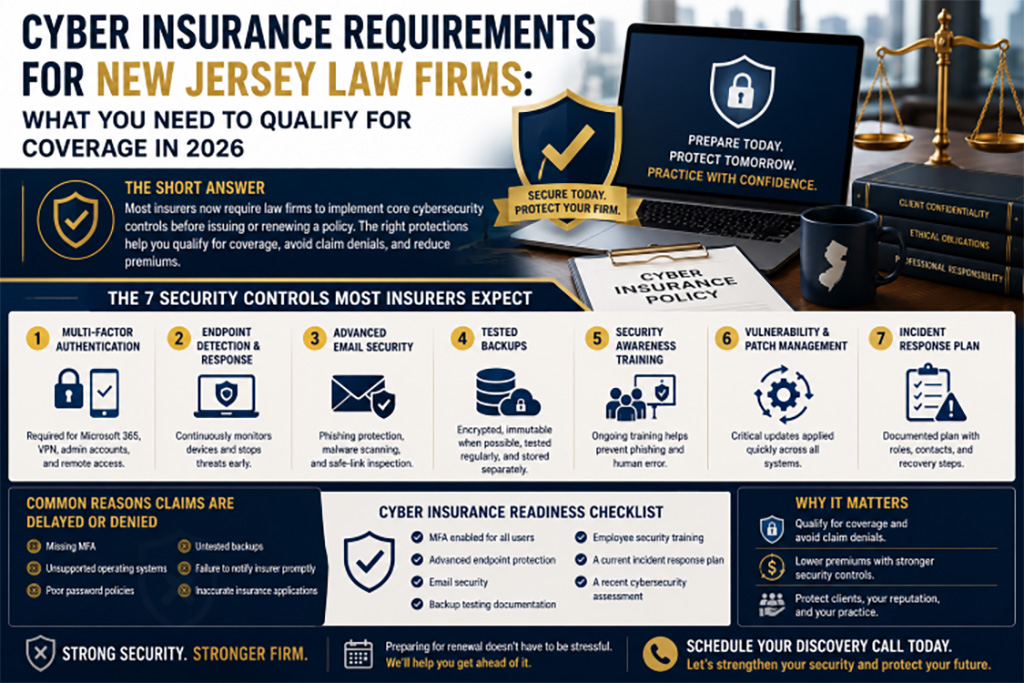
The Short Answer
Cyber insurance has become an essential part of risk management for New Jersey law firms. However, obtaining or renewing coverage is no longer as simple as filling out an application. Most insurers now require firms to demonstrate that they have implemented core cybersecurity controls before a policy is issued or renewed.
For firms with 15–75 employees, the most commonly required safeguards include multi-factor authentication (MFA), endpoint detection and response (EDR), secure backups, email security, employee security awareness training, and documented incident response procedures.
If these controls are missing, your firm could face higher premiums, limited coverage, or even denial of a claim after a cyber incident.
This guide explains what insurers are looking for and how your firm can prepare before renewal season.
Find out how we can help you schedule your discovery call.
Why Cyber Insurance Requirements Have Changed
Cyberattacks have become more frequent, more sophisticated, and more expensive.
Rather than simply accepting the risk, insurers now expect businesses to actively reduce it.
As a result, underwriting questionnaires have become significantly more detailed and often require proof that critical security controls are in place.
The Seven Security Controls Most Insurers Expect
1. Multi-Factor Authentication
Required for:
- Microsoft 365
- VPN access
- Administrator accounts
- Remote access
2. Endpoint Detection & Response (EDR)
Modern ransomware protection that continuously monitors devices for suspicious activity.
3. Advanced Email Security
Including phishing protection, malware scanning, and safe-link inspection.
4. Tested Backups
Backups should be:
- Encrypted
- Immutable where possible
- Tested regularly
- Stored separately from production systems
5. Security Awareness Training
Most breaches begin with phishing. Ongoing employee education is now considered a fundamental security control.
6. Vulnerability & Patch Management
Insurers increasingly ask how quickly critical security updates are applied across your environment.
7. Incident Response Plan
Your firm should have documented procedures for responding to a cyber incident, including internal contacts, legal counsel, insurance notifications, and recovery steps.
Common Reasons Claims Are Delayed or Denied
- Missing MFA
- Unsupported operating systems
- Poor password policies
- Untested backups
- Failure to notify the insurer promptly
- Inaccurate insurance applications
Cyber Insurance Readiness Checklist
Before renewal, confirm that your firm has:
- MFA enabled for all users
- Advanced endpoint protection
- Email security
- Backup testing documentation
- Employee security training
- A current incident response plan
- A recent cybersecurity assessment
Real Client Scenario
A New Jersey law firm preparing for its annual cyber insurance renewal engaged Genesis Network Group to review its security posture. The assessment identified several opportunities to strengthen authentication, verify backup testing, and improve documentation. After implementing the recommended controls, the firm entered the renewal process with greater confidence and a stronger overall security posture.
Why Genesis Network Group
For more than 30 years, Genesis Network Group has helped professional service firms strengthen cybersecurity and prepare for evolving business risks.
Our cybersecurity-first approach includes:
- Cyber insurance readiness assessments
- Multi-layered security
- Continuous monitoring
- Live phone support
- Strategic IT planning
- A 100% Satisfaction Guarantee—if you're not satisfied, you don't pay
- Find out how we can help you schedule your discovery call.
Call to Action
Preparing for cyber insurance renewal shouldn't be a last-minute scramble.
Schedule a cybersecurity assessment with Genesis Network Group to identify gaps, strengthen your defenses, and improve your firm's readiness before your next renewal.
Find out how we can help you schedule your discovery call.