 The Short Answer
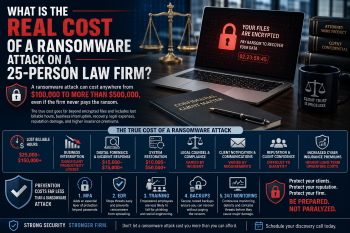
For a 25-person law firm, a ransomware attack can cost anywhere from $100,000 to more than $500,000, even if the firm never pays the ransom. The true cost extends far beyond encrypted files and includes lost billable hours, business interruption, forensic investigations, legal expenses, recovery efforts, reputational damage, and higher cyber insurance premiums.
For firms that depend on constant access to client files, calendars, document management systems, and email, even a single day of downtime can have a significant financial impact.
This guide breaks down where those costs come from, what happens during a ransomware incident, and the practical steps every law firm can take to reduce its risk.
Find out how we can help you schedule your discovery call.
Why Law Firms Are a Prime Target
Cybercriminals view law firms as attractive targets because they manage highly valuable and confidential information, including:
- Client files
- Litigation documents
- Contracts
- Intellectual property
- Financial records
- Wire transfer instructions
- Personally identifiable information (PII)
Attackers also know that law firms depend on continuous access to their systems. The pressure to restore operations quickly can make firms more likely to consider paying a ransom.
The True Cost of a Ransomware Attack
Many business owners assume the ransom payment is the largest expense. In reality, it is often only one part of the overall financial impact.
| Cost Category | Potential Impact |
| Lost billable hours | $25,000–$150,000+ |
| Business interruption | Significant productivity losses |
| Digital forensics & incident response | $15,000–$75,000+ |
| System restoration | $10,000–$50,000+ |
| Legal counsel & compliance | Varies by incident |
| Client notification & communications | Varies by requirements |
| Reputation and client confidence | Difficult to quantify |
| Increased cyber insurance premiums | Higher long-term operating costs |
Every incident is different, but the financial impact often extends for months after systems have been restored.
The First 24 Hours After a Ransomware Attack
The first day is critical. Having a documented incident response plan can dramatically reduce confusion and recovery time.
Step 1: Isolate Affected Systems
Disconnect infected computers and servers from the network to limit the spread of malware.
Step 2: Contact Your IT and Cybersecurity Team
Notify your managed IT provider and cybersecurity specialists immediately. Early containment can significantly reduce the scope of the incident.
Step 3: Notify Your Cyber Insurance Carrier
Many cyber insurance policies require prompt notification and may specify approved forensic investigators or legal counsel.
Step 4: Preserve Evidence
Avoid wiping systems before investigators determine how the attack occurred. Preserving evidence supports both recovery efforts and insurance claims.
Step 5: Restore Operations Safely
Recover systems from verified backups only after the environment has been secured and the threat has been removed.
Five Security Investments That Cost Far Less Than a Ransomware Attack
The most effective cybersecurity strategy focuses on prevention and preparedness.
1. Multi-Factor Authentication (MFA)
Reduces the risk of unauthorized access by requiring an additional verification step beyond a password.
2. Endpoint Detection & Response (EDR)
Continuously monitors endpoints for suspicious activity and helps stop ransomware before it spreads.
3. Security Awareness Training
Employees who can recognize phishing emails are less likely to trigger a ransomware attack.
4. Secure, Tested Backups
Regularly tested backups provide a reliable path to recovery without depending on attackers.
5. 24/7 Monitoring
Continuous monitoring helps identify and contain threats before they cause widespread disruption.
Compared to the potential financial impact of a ransomware incident, these investments are typically modest and provide long-term protection.
How to Reduce Your Firm's Risk
A practical cybersecurity framework includes:
Assess Your Current Environment
Identify outdated systems, unsupported software, and security gaps.
Implement Layered Security
Use multiple security controls rather than relying on a single product or solution.
Test Your Backups
A backup is only valuable if it can be restored successfully.
Train Your Team
Human error remains one of the leading causes of successful cyberattacks.
Review Your Incident Response Plan
Ensure your team knows who to contact and what actions to take before an emergency occurs.
Real Client Scenario
A Northern New Jersey law firm experienced a phishing attempt that could have resulted in a ransomware attack. Because Genesis Network Group implemented multi-factor authentication, endpoint detection and response, advanced email filtering, and monitored backups, the malicious activity was detected quickly and contained before files were encrypted. The firm resumed normal operations with minimal disruption and no ransom payment.
Why Genesis Network Group
For more than 30 years, Genesis Network Group has helped organizations throughout Northern New Jersey strengthen their cybersecurity and reduce operational risk.
Our approach includes:
- Cybersecurity-first managed IT services
- Continuous monitoring
- Advanced endpoint protection
- Live phone support
- Strategic technology planning
- A 100% Satisfaction Guarantee—if you're not satisfied, you don't pay
We focus on helping clients prevent incidents, respond effectively when threats occur, and build resilient technology environments.
Find out how we can help you schedule your discovery call. https://go.scheduleyou.in/QeuydhB4km?cid=is:~Contact.Id~
Frequently Asked Questions
Should a law firm ever pay a ransomware demand?
Every incident is different. Decisions should be made with guidance from legal counsel, cybersecurity professionals, law enforcement where appropriate, and your cyber insurance carrier. Paying a ransom does not guarantee that data will be recovered or that stolen information will not be disclosed.
Can a small law firm really be targeted?
Yes. Small and midsize firms are frequent targets because they often manage valuable data while having fewer internal cybersecurity resources than larger organizations.
How long does ransomware recovery take?
Recovery timelines vary depending on the scope of the attack, the quality of backups, and the organization's preparedness. Firms with documented recovery procedures and tested backups generally recover much faster than those without them.
Does cyber insurance cover ransomware?
Many policies provide coverage for certain ransomware-related expenses, but coverage varies and often depends on whether required security controls—such as MFA and endpoint protection—were in place before the incident.
Don't Wait Until an Attack Becomes a Business Crisis
Ransomware isn't just a technology problem—it can interrupt client service, delay legal matters, affect revenue, and damage the trust your firm has worked hard to build.
Genesis Network Group helps law firms throughout Northern New Jersey reduce cyber risk through proactive managed IT services, layered cybersecurity, continuous monitoring, and strategic planning.
If you're unsure whether your firm's current defenses are adequate, a cybersecurity assessment is one of the most effective ways to identify vulnerabilities before attackers do.
Find out how we can help you schedule your discovery call.