
The Short Answer
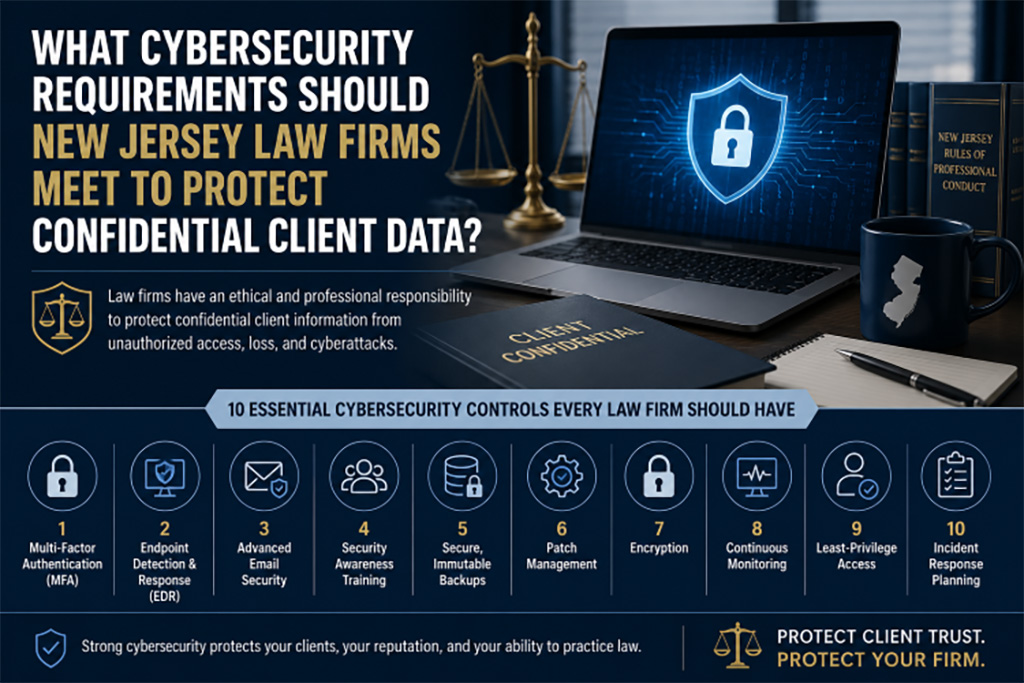
New Jersey law firms have an ethical and professional responsibility to protect confidential client information from unauthorized access, loss, and cyberattacks. While there isn't a single cybersecurity law that applies exclusively to law firms, firms are expected to implement strong security controls that align with the American Bar Association's guidance, New Jersey Rules of Professional Conduct, client security expectations, cyber insurance requirements, and applicable privacy laws.
At a minimum, every law firm should have 10 core cybersecurity controls in place, including multi-factor authentication (MFA), endpoint detection and response (EDR), advanced email security, immutable backups, security awareness training, encryption, continuous monitoring, and a documented incident response plan.
This guide explains what those requirements are, why they matter, and how your firm can reduce cyber risk while protecting client trust.
Find out how we can help you schedule your discovery call. https://go.scheduleyou.in/QeuydhB4km?cid=is:~Contact.Id~
Why Cybersecurity Is Critical for Law Firms
Law firms are prime targets for cybercriminals because they store highly valuable information, including:
- Client communications
- Litigation files
- Contracts
- Intellectual property
- Financial records
- Wire transfer instructions
- Personally identifiable information (PII)
Unlike many businesses, attorneys also have ethical obligations to preserve confidentiality. A successful cyberattack can disrupt operations, expose sensitive information, and damage the trust clients place in your firm.
Cybersecurity is no longer just an IT issue, it's a business risk that affects your reputation, your clients, and your ability to practice law.
The 10 Essential Cybersecurity Controls Every Law Firm Should Have
1. Multi-Factor Authentication (MFA)
Passwords alone are no longer enough. MFA adds an additional verification step that significantly reduces the risk of unauthorized access to Microsoft 365, legal applications, VPNs, and cloud services.
2. Endpoint Detection & Response (EDR)
Modern antivirus software isn't sufficient against today's threats. EDR continuously monitors computers for suspicious activity, helping stop ransomware and other advanced attacks before they spread.
3. Advanced Email Security
Email remains the most common entry point for cyberattacks. Effective protection should include:
- Spam filtering
- Phishing detection
- Malware scanning
- Safe link protection
- Attachment sandboxing
4. Security Awareness Training
Employees are your first line of defense. Ongoing training helps attorneys and staff recognize phishing attempts, suspicious links, and social engineering tactics.
5. Secure, Immutable Backups
Backups are essential, but they must also be protected from tampering. Immutable backups cannot be altered or encrypted by ransomware, allowing your firm to recover data more quickly after an incident.
6. Patch Management
Cybercriminals often exploit known software vulnerabilities. Promptly applying security updates to operating systems, applications, firewalls, and network devices helps reduce these risks.
7. Encryption
Sensitive information should be encrypted both while it's being transmitted and while it's stored. Encryption protects client data even if a device is lost or stolen.
8. Continuous Monitoring
Around-the-clock monitoring allows suspicious activity to be identified and addressed before it becomes a larger incident.
9. Least-Privilege Access
Employees should have access only to the systems and information necessary for their role. Limiting permissions reduces the impact of compromised accounts.
10. Incident Response Planning
Every law firm should have a documented plan that outlines:
- Who to contact
- How to isolate affected systems
- How to communicate with clients
- Recovery procedures
- Roles and responsibilities
Planning ahead can significantly reduce downtime during an incident.
Ethical and Regulatory Considerations
Law firms don't operate under a single cybersecurity regulation, but they are expected to take reasonable steps to safeguard client information.
Important considerations include:
- ABA Model Rule 1.1 – Technology competence
- ABA Model Rule 1.6 – Protecting confidential client information
- New Jersey Rules of Professional Conduct
- Cyber insurance security requirements
- Client contractual security obligations
- Applicable privacy laws based on the data your firm handles
Firms serving clients in regulated industries may also need to consider requirements under laws such as HIPAA or the Gramm-Leach-Bliley Act (GLBA).
Common Cybersecurity Mistakes Law Firms Make
| Mistake | Risk | Better Practice |
| No MFA | Account compromise | Require MFA for all users |
| Weak or reused passwords | Credential theft | Use password managers and strong password policies |
| Infrequent software updates | Exploited vulnerabilities | Automate patch management |
| Untested backups | Failed recovery | Test backups regularly |
| No employee training | Successful phishing attacks | Provide ongoing awareness training |
| Excessive user permissions | Greater damage after compromise | Apply least-privilege access |
How to Evaluate Your Firm's Cybersecurity
A practical five-step approach:
Step 1: Inventory Your Technology
Document users, devices, servers, cloud services, and software.
Step 2: Identify Risks
Assess vulnerabilities such as unsupported hardware, weak authentication, or outdated software.
Step 3: Prioritize Improvements
Address high-risk issues first, especially those affecting confidential client information.
Step 4: Implement Layered Security
Combine preventive, detective, and recovery controls to reduce risk.
Step 5: Review Regularly
Cybersecurity is not a one-time project. Schedule regular reviews, risk assessments, and backup testing.
Choosing an MSP That Understands Law Firms
When evaluating technology partners, ask:
- Do you support other law firms?
- Is cybersecurity included in every managed IT agreement?
- How do you help clients meet cyber insurance requirements?
- What monitoring is performed after business hours?
- Do you answer support calls live?
- Can you help with incident response?
- Will you provide strategic security guidance throughout the year?
A qualified MSP should be proactive, not reactive.
Real Client Scenario
A Northern New Jersey law firm with approximately 28 employees asked Genesis Network Group to evaluate its cybersecurity posture after receiving updated cyber insurance requirements. The assessment identified opportunities to strengthen authentication, endpoint protection, and backup verification. By implementing a layered security strategy and improving employee awareness, the firm enhanced its security posture and was better prepared to meet insurer expectations.
Why Genesis Network Group
For more than 30 years, Genesis Network Group has helped businesses throughout Northern New Jersey protect their technology and confidential information.
Our approach combines:
- Cybersecurity-first managed IT services
- Live phone support
- Continuous monitoring
- Strategic technology planning
- Local engineers who understand the needs of professional service firms
- A 100% Satisfaction Guarantee—if you're not satisfied, you don't pay
We believe cybersecurity should be built into every managed IT relationship, not treated as an optional add-on.
Find out how we can help you schedule your discovery call. https://go.scheduleyou.in/QeuydhB4km?cid=is:~Contact.Id~
Frequently Asked Questions
Is cybersecurity required for law firms?
While no single law governs every law firm, attorneys have ethical obligations to safeguard confidential client information and should implement reasonable cybersecurity measures.
Does cyber insurance require specific security controls?
Many insurers now require controls such as MFA, endpoint protection, email security, and tested backups before issuing or renewing coverage.
How often should a law firm perform a cybersecurity assessment?
At least annually, and whenever there are significant technology changes, mergers, or new regulatory obligations.
Can a small law firm be targeted by ransomware?
Yes. Cybercriminals frequently target small and medium-sized firms because they often have fewer security resources but still store valuable client information.
Protect Your Firm Before an Incident Happens
Cybersecurity is far less expensive than recovering from a breach.
If you're unsure whether your current IT environment meets today's security expectations, Genesis Network Group can perform a comprehensive cybersecurity assessment, identify gaps, and provide practical recommendations tailored to your firm's size, technology, and business goals.
Protecting confidential client information isn't just about compliance, it's about maintaining the trust your clients place in your firm every day.
Find out how we can help you schedule your discovery call.